Can You See Northern Lights in Rovaniemi Without a Tour?
Can you see Northern Lights in Rovaniemi without a tour? Yes, learn the best walkable spots, the apps to use, and when self-hunting works (and when a tour is the smarter move).
Free viewing stays a valid choice when the sky cooperates. A guided alternative pays for transport, a particular evening format and photography help rather than ownership of the sky.
Keep the walkable options above. Compare a flexible chase, a shorter lake-and-tipi evening or a photography night only if those services fit your plans.
Last updated: April 9, 2026
Self-Guided Aurora Viewing in Rovaniemi: Quick Reference
| Spot | ||||
|---|---|---|---|---|
| Arctic Garden (Arktikum park) | ~1 km / 10-15 min walk | On foot, no transport needed | Moderate (riverside, darker edges) | Strong displays; easy first stop |
| Ounasjoki / Kemijoki riverbanks | ~0.5-1 km walk | On foot from most city hotels | Low–moderate (open sky over river) | Open horizon views; no uphill required |
| Ounasvaara hill | ~3 km / 30-45 min walk or 10 min taxi | Walk, taxi, or bus | Low (elevation above city glow) | Best elevated city-accessible spot |
| Olkkajärvi lake area | ~15 km / 15 min by taxi/car | Taxi or rental car | Very low (open lake, forest, no city) | First genuinely dark-sky location |
| Arctic Circle Hiking Area | ~20 km / 20 min by car | Car or taxi required | Minimal (full wilderness darkness) | Best conditions for weaker displays |
| Koivusaari island (Ounasjoki delta) | ~2 km / 20 min walk | On foot via E75 bridge | Low (island, open sky all directions) | Photography composition, river reflections |
Distances approximate. Always walk on cleared paths and avoid frozen river/lake surfaces without verified ice thickness. Verified April 2026.
Can You See the Northern Lights in Rovaniemi Without a Tour?
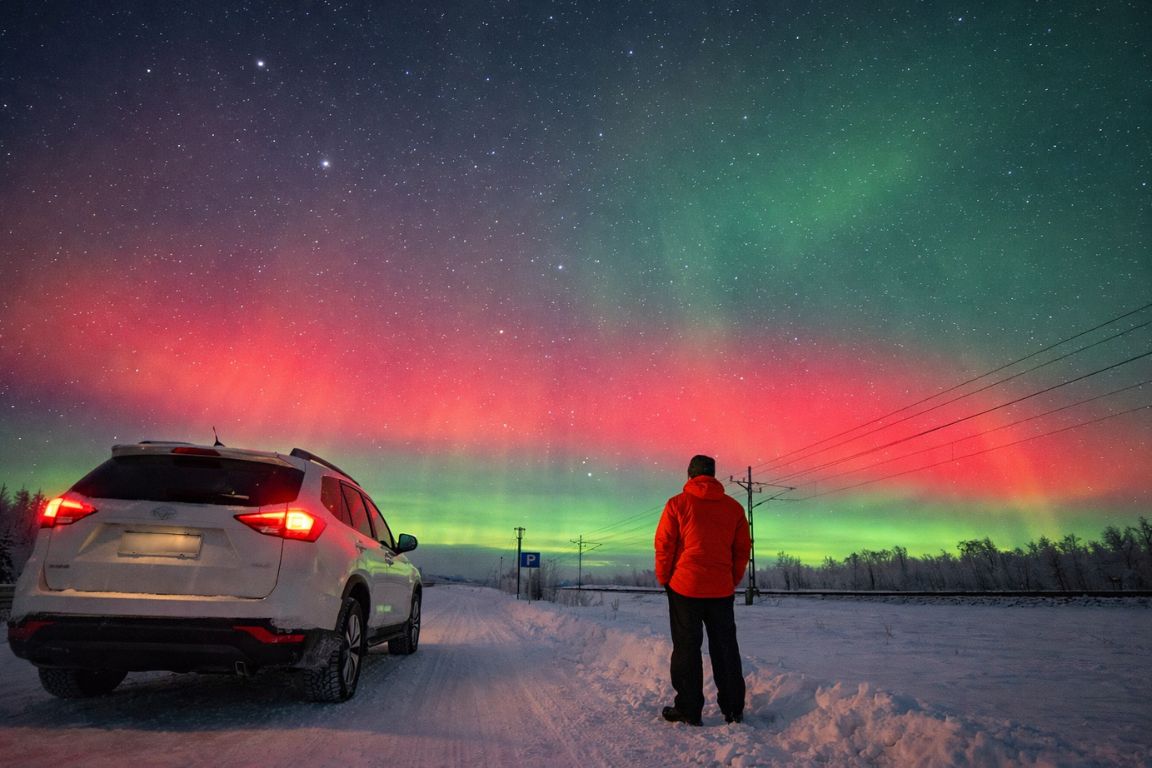 Yes. Rovaniemi is one of the most accessible aurora destinations in the world and is specifically set up for independent viewing – public dark-sky spots are within walking distance of the city center, apps provide real-time alerts, and on strong activity nights with clear sky, the lights are visible from parks and riverbanks without any tour infrastructure required. The honest constraint: self-hunting from a fixed city location fails on cloudy nights when clear sky exists elsewhere. A tour adds mobility; self-hunting adds freedom, cost savings, and often the most memorable solo experience of a Lapland trip.
After guiding thousands of travelers through Rovaniemi, I have watched people come back from a self-guided night having seen their first aurora from the Arctic Garden – a free park 15 minutes from their hotel – with the kind of quiet elation that comes from having found something rather than been taken to it. That experience is real and repeatable. It requires nothing beyond correct information, patience, and the right clothing for standing still in the Arctic dark.
What it requires in honesty: cloud cover defeats it entirely. When Rovaniemi is overcast but Levi, 170 km north, has a clear window at 11pm, a guided tour with mobility gets aurora that night. A traveler in the Arctic Garden sees cloud. This is the one limitation of city-based self-hunting that no amount of good equipment or determination can overcome. On clear nights, self-hunting works exceptionally well. On clouded nights where clear sky requires driving, it does not. Knowing which situation you are in on any given evening is what the apps are for.
What Are the Best Free Spots to Watch the Aurora in Rovaniemi?
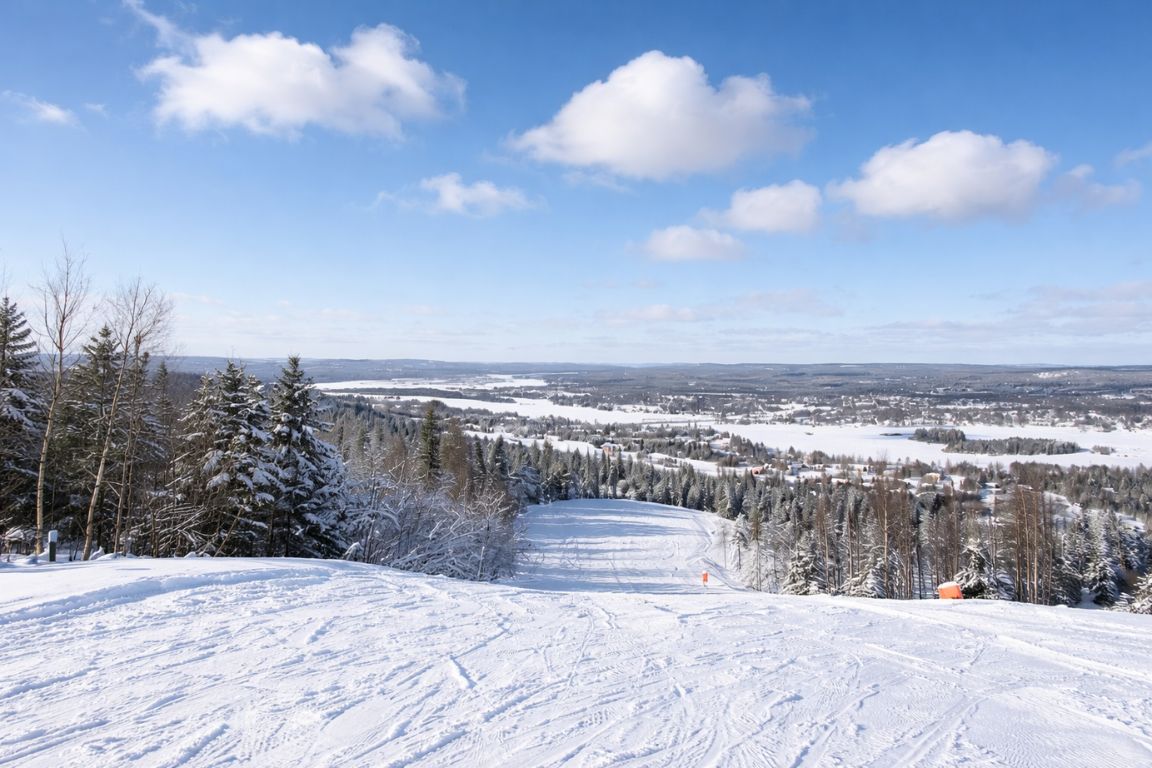 The four publicly designated aurora viewing locations near Rovaniemi city center are: the Arctic Garden behind Arktikum museum (10 to 15 minutes on foot from most hotels, river views north), the Ounasjoki and Kemijoki riverbanks (open sky, multiple access points, good aurora reflections on the frozen river), Ounasvaara hill (30 to 45 minutes on foot or 10 by taxi, elevated position above city light pollution), and Koivusaari island in the river delta (20-minute walk, 360-degree sky, photography-friendly). Beyond the city, Olkkajärvi lake at 15 km and the Arctic Circle Hiking Area at 20 km are the first genuinely dark-sky locations.
The Arctic Garden is where most city-based aurora hunting begins for good reason. The seven-hectare park surrounds the Arktikum Science Museum along the Ounasjoki river, giving open riverbank views pointing directly north – the direction where aurora arches first build. The architecture of the Arktikum building itself, with its long glass corridor extending 200 metres toward the north, creates a natural composition reference for photography. The park has some ambient light from the city, but the darker edges along the river reduce it meaningfully. On strong activity nights – KP 3 and above, clear sky – aurora is reliably visible here. The walk from the main hotel strip takes 10 to 15 minutes through quiet residential streets.
One thing about the Arctic Garden that guides rarely mention: timing is everything. The classic mistake is arriving at 10pm, standing for 15 minutes, seeing nothing, and leaving. Aurora activity follows cycles. A display that builds between 10:30pm and midnight may not be visible at 10pm from the same spot. The traveler who waits 90 minutes at the Arctic Garden on a clear, moderately active night will see the lights in a higher percentage of cases than the traveler who checks for 15 minutes and concludes the forecast was wrong.
Ounasvaara hill is the step up when the city’s ambient glow feels too present. The forested hill across the river sits elevated above the urban area, giving a panoramic north-facing view with noticeably less light pollution than the flat city. The Ounasvaara observation tower at the top provides the best elevated vantage point available within easy reach of the center. It does fill up on active nights – the platform has limited space and other aurora hunters will be there. Take the trails that run left and right from the Lapland Hotels Sky Ounasvaara building to find open spots away from the tower crowds. Active guests at Santasport Resort, Arctic TreeHouse Hotel, and Sky Ounasvaara are already positioned here.
Koivusaari island is the local photographer’s choice that fewer tourists discover. The island sits in the Ounasjoki river delta, connected to the city by the E75 road bridge, about 20 minutes on foot from the center. The island gives a full 360-degree sky and the river on multiple sides creates aurora reflection compositions. It is darker than the Arctic Garden while remaining walkable. The path around the island is manageable in winter boots. Do not wade out onto the river ice to improve your composition; the ice thickness varies and this is genuinely hazardous.
For travelers who want to try self-hunting beyond walking distance, Olkkajärvi lake is the natural next step. Fifteen km from the city center – a €20 to €25 taxi ride each way – the lake sits in open forest with no surrounding light sources. The difference in sky quality compared to the Arctic Garden on the same night is noticeable. The aurora’s greens are deeper, fainter arches become visible, and the silence is complete. Stay at the maintained rest area by the lake rather than wandering onto the ice surface.
What Apps and Tools Do You Need to Self-Hunt Aurora in Rovaniemi?
Three tools cover everything a self-guided aurora hunter in Rovaniemi needs: Northern Lights Alert (nlalert.fi) for real-time camera-verified sightings across Finnish Lapland – the only service using physical camera networks rather than satellite data alone; the Finnish Meteorological Institute cloud service at ilmatieteenlaitos.fi for accurate local cloud cover mapping; and Windy (or the FMI’s own app) for cloud movement forecasts showing which direction systems are moving and when gaps might appear. The KP index alone, from any app, is insufficient for on-the-ground decision-making in Rovaniemi.
The KP index is where most travelers start and where many of them stop, which leads to confusion. The KP index measures global geomagnetic activity on a scale of 0 to 9. It updates every 3 to 6 hours and represents a global average, not what is happening over your specific location in this specific moment. A KP of 2 when your sky is completely overcast means you will see nothing. A KP of 1 when the sky above Rovaniemi is crystal clear and cold air has settled may produce visible aurora. The index is a planning tool, not a go/no-go switch.
Northern Lights Alert solves the real-time problem that satellite-based apps cannot. The service maintains a network of physical cameras positioned across Finnish Lapland, including specifically in the Rovaniemi area. When the cameras detect actual aurora activity – not predicted activity, actual visible aurora confirmed by the camera image – the app sends an alert. This is categorically different from an app saying “KP is 3, aurora is possible.” Northern Lights Alert says: “Aurora is currently visible from this camera position in Lapland right now.” The distinction produces meaningfully fewer false alarms. A login key tied to the Rovaniemi location is required; they are available for purchase or included with some accommodations.
Cloud cover mapping is the other half of the equation. The FMI weather service at ilmatieteenlaitos.fi provides cloud cover data for Finnish Lapland that is more accurate for this specific region than international services like AccuWeather or Weather.com, which aggregate data from broader areas. Windy’s cloud layer (accessible at windy.com or through the Windy app) shows cloud movement in real time, which allows you to see whether a cloud system is clearing or building over Rovaniemi over the next few hours. If Windy shows a clearing front arriving from the northwest at 11pm, go out at 10:45pm. If it shows cloud consolidating from the north, stay warm indoors until the pattern changes.
The Bz component of the interplanetary magnetic field is the advanced indicator that experienced hunters monitor for real-time aurora activity. When Bz turns strongly negative (southward), aurora activity intensifies within 30 to 60 minutes. This data is available through Space Weather Live (spaceweatherlive.com), NOAA’s real-time solar wind display, and some aurora apps. It is not necessary for casual self-hunting but is the variable local guides watch when deciding whether to keep driving or stop and wait.
Aurora Self-Hunt Tool Kit
| Tool | |||
|---|---|---|---|
| Northern Lights Alert (nlalert.fi) | Real-time aurora sighting confirmed by cameras | Login key ~€6-10 | Go/no-go decision in real time |
| FMI cloud service (ilmatieteenlaitos.fi) | Cloud cover over Finnish Lapland specifically | Free | Checking sky conditions before going out |
| Windy (windy.com / app) | Cloud movement forecast – arriving or clearing | Free | Timing departures around cloud gaps |
| My Aurora Forecast & Alerts (app) | KP index, probability map, weeks-ahead planning | Free (ads) / premium | Trip planning, general activity forecast |
| Hello Aurora (app) | Community sightings, local magnetometer data | Free / premium | Real-time community confirmation near you |
| Space Weather Live (spaceweatherlive.com) | Bz component, solar wind, real-time data | Free | Advanced real-time aurora intensity monitoring |
What Conditions Do You Actually Need to See the Northern Lights?
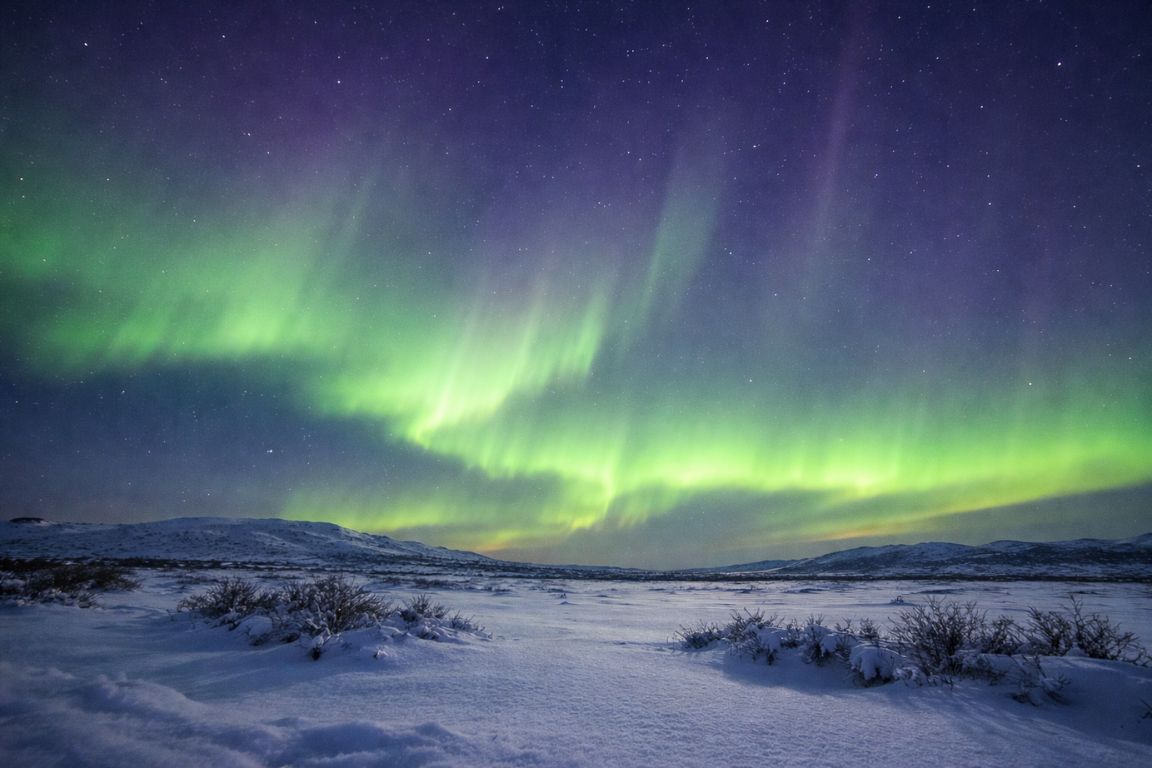 Three conditions must align simultaneously: darkness (season must be late August to mid-April, and you must be outside after civil twilight ends), clear sky (even thin cloud blocks aurora entirely since displays occur 100 to 300 km above Earth), and sufficient geomagnetic activity (Rovaniemi’s latitude of 66.6° needs a minimum KP of around 2 for faint aurora, and KP 3 to 4 for reliable overhead displays). Of these three, clear sky is the one travelers most underestimate and the one that kills otherwise perfect nights most frequently.
Darkness is the simplest condition. The aurora season runs late August to mid-April; outside those dates, the sky never gets dark enough for the lights to show regardless of solar activity. Within the season, you need to be outside after the sky has fully darkened – roughly one to two hours after sunset, depending on the month. December and January have the longest dark windows; September and March have shorter but often clearer ones.
Want to do December in Rovaniemi right without overpaying or fighting crowds at every turn? Our guide on Rovaniemi tours in December covers the booking strategies and timing tricks that make peak season actually enjoyable.
Clear sky is the condition that causes most confusion and disappointment. The aurora occurs in Earth’s upper atmosphere, 100 to 300 km above the surface. Even a thin layer of cloud at a few thousand metres altitude is completely opaque to it. A night with KP 5 activity producing dramatic displays visible from Norway or northern Sweden produces absolutely nothing from under a cloud layer in Rovaniemi. This is why experienced aurora hunters track cloud cover more carefully than KP index. A KP 2 night with perfectly clear sky above Rovaniemi is often better hunting than a KP 4 night with 70% cloud cover.
Geomagnetic activity at Rovaniemi’s latitude is forgiving compared to destinations further south. The city sits at approximately 66.6° magnetic latitude, within the auroral zone. KP 2 events are common several times per month during aurora season and produce faint arches visible from dark locations. KP 3 produces arches growing toward the zenith, with some vertical curtaining. KP 4 gives overhead displays that fill large portions of the sky. KP 5 and above – storm-level events – can produce full-sky corona displays, which are the ones that overwhelm photographers and make people cry.
One thing camera users should understand before going out: long-exposure photography shows aurora much more vividly than the naked eye sees it. An arch that appears as a faint pale band on the northern horizon in person can look like a blazing green curtain in a 15-second exposure at ISO 3200. This is not deception, it is the physics of long-exposure photography capturing photons over time that the eye cannot accumulate. First-time aurora viewers sometimes feel slightly disappointed by what they see in person compared to photographs. The experience of standing beneath a moderate aurora and watching it move and develop is extraordinary regardless of its photographic appearance. But it helps to know the difference before you go out expecting the photos you have seen.
First time planning a trip around the aurora? Here’s the best time to see Northern Lights in Rovaniemi tours so you don’t spend a week in Lapland under cloudy skies wondering what went wrong.
What Time of Night Should You Go Out?
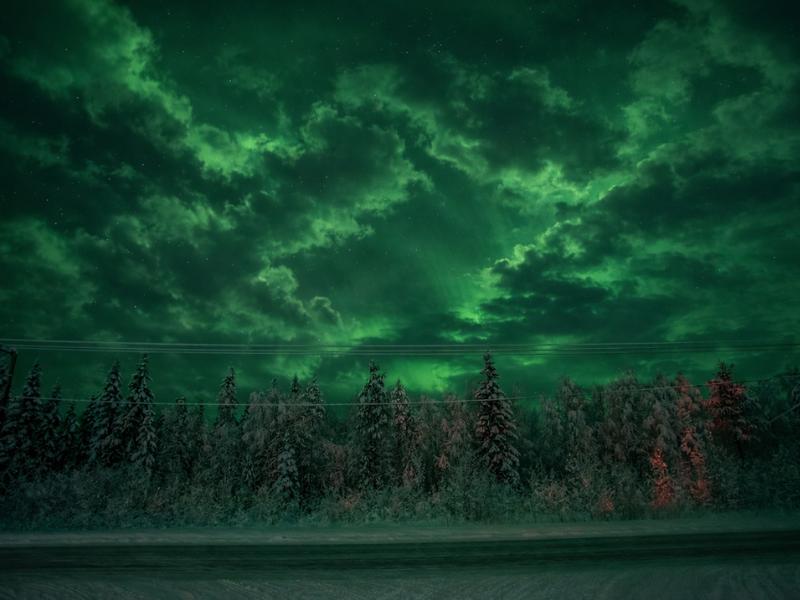
The Finnish Meteorological Institute identifies 9pm to 1am local time as the peak aurora window, with activity typically peaking around magnetic midnight – approximately 11pm to midnight in Rovaniemi. Displays can begin as early as 7pm on strong activity evenings and persist past 3am. The single most common self-hunting mistake is going out for 15 to 20 minutes and leaving too early. Aurora activity builds in cycles; the sky that shows nothing at 9:30pm may be dancing at 10:45pm from the same location.
Magnetic midnight is the moment when your location is directly between the magnetic poles and the sun – the peak connection point for aurora activity. At Rovaniemi, this falls around 11pm to midnight. Activity consistently peaks in this window across the season, which is why guide experience and traveler accounts converge on the same recommendation. Going out at 8pm and returning at 9:30pm misses the statistically most active period of the night on most occasions.
The 15-minute check-and-leave pattern is what local guides see most in traveler accounts of missed aurora. Someone walks to the Arctic Garden, looks up for a few minutes at a quiet sky, and concludes the app was wrong. What they missed is that aurora activity fluctuates in 20 to 40 minute cycles. A quiet period at 10pm can give way to a sudden brightening at 10:25pm as a solar wind fluctuation intensifies. The traveler who stayed – perhaps sitting on a thermal mat, hands in their pockets, watching the stars – sees it. The one who went back to the hotel for warmth misses it.
In practical terms: if you go out to self-hunt, commit to a minimum of 90 minutes at your chosen spot on a clear night. This is long enough to capture a full activity cycle and short enough to remain manageable temperature-wise with correct preparation. Set your Northern Lights Alert app notifications before leaving your hotel so you receive the alert even if the display begins while you are walking. The phone vibrates. You look up.
How Do You Stay Warm While Waiting for the Aurora?
Standing still in minus 20°C is fundamentally different from walking in minus 20°C, and most travelers underestimate this until they have experienced it. The layering system for static cold is: thermal base (moisture-wicking, not cotton), insulating mid-layer (wool or fleece), and windproof outer layer – plus the critical additions of a second thermal bottom layer for legs, mittens over inner gloves, boots rated to minus 30°C minimum, a neck gaiter covering the lower face, and chemical hand and toe warmers inside boots. Returning to a heated café or hotel between viewing windows is a fully legitimate warmth strategy, not a failure of commitment.
The feet are where most people lose the battle. When you are standing still on a frozen surface – whether concrete or snow – cold conducts upward through your boots faster than it does when you are moving. Boots rated for skiing, which are designed for movement, often fail at providing warmth for extended static standing. Look for boots rated to minus 30°C or below, with thermal insoles added if needed. Chemical toe warmers placed inside the sock (not directly against skin) add meaningful protection on the coldest nights. Several travelers report discovering this the hard way at 11pm when their feet have been numb for 30 minutes and they are still 20 minutes from a warm building.
The warmth cycling approach is used by experienced local aurora hunters and works extremely well for city-based self-hunting. Pick a spot close to a warm building – a hotel lobby, a restaurant, a café. Check the sky every 30 to 40 minutes. When nothing is happening, go back inside, warm up properly, have a hot drink, check the app. Repeat. This is not less effective than standing outside continuously; it is arguably more effective because it allows you to remain patient over a longer total viewing window without the cold degrading your judgment and comfort. Someone who cycles in and out from the restaurant adjacent to the Arctic Garden over four hours has more total aurora-watching time than someone who stands outside for 90 minutes and retreats to bed from cold.
A thermal sit mat – the kind cross-country skiers use, available for a few euros from any Finnish outdoor shop – transforms sitting on a snow-covered bench or log from unthinkable to comfortable. Aurora hunters who plan independent viewing sessions often carry one folded in a backpack. Combined with a thermos of hot coffee or berry juice, a thermal mat turns waiting from an endurance test into something genuinely pleasant. The Finnish relationship with standing and sitting in cold forests is different from that of most visitors; they have simply prepared for it correctly.
When Does Self-Hunting Work and When Does a Tour Win?
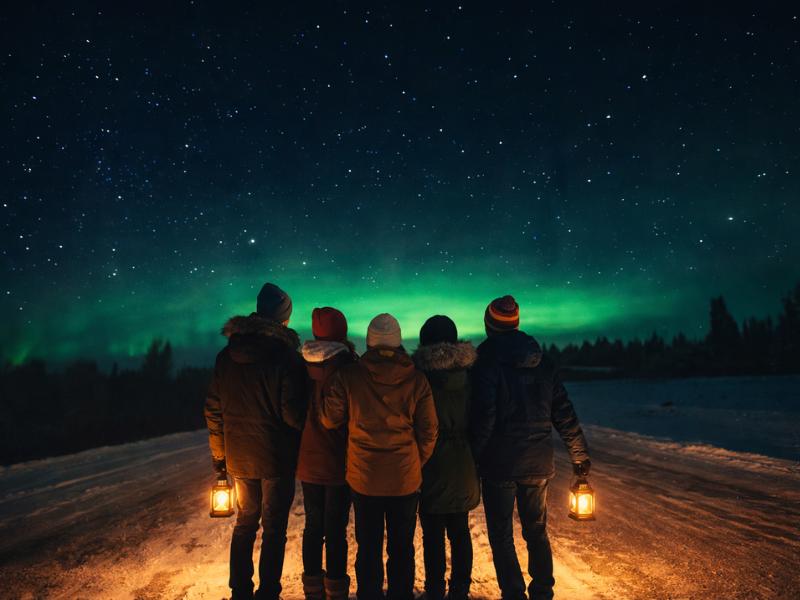
Self-hunting works best when: the sky over Rovaniemi is clear and aurora activity is KP 2 or above; you have multiple nights to attempt viewing and can be patient; you are comfortable with the app tools and clothing requirements; and you are staying in the city center within walking distance of dark spots. A tour wins when: cloud covers the city but clear sky exists within driving distance; you have only one or two nights and cannot afford to miss; you specifically want professional DSLR photos of yourself with the aurora; or you prefer the guided experience and narrative over the solo hunt.
The city-based self-hunter’s fundamental constraint is spatial. From the Arctic Garden, you can see aurora above the sky directly overhead and toward the north. You cannot follow a cloud gap 150 km to the northwest. A guided tour with unlimited mileage can. On a typical Rovaniemi winter night where cloud partially covers the city but openings exist within reasonable driving distance, a guide with weather radar finds the opening and drives to it. The client who was standing at the Arctic Garden under the cloud sees nothing; the client in the guide’s van sees aurora.
Chasing the Northern Lights from your bed? Our guide on where to stay in Rovaniemi tours walks you through the best glass igloo resorts and aurora cabins worth the splurge.
The math changes with longer stays. A traveler spending seven nights in Rovaniemi can check the sky independently every evening, use apps to time their outings for clear windows, and is likely to encounter two or three clear nights with adequate activity. Over a week, the cost difference between zero tours and two or three tours becomes significant, and the independent sightings may be as satisfying as guided ones. A traveler spending three nights has much less statistical room to absorb a bad-luck overcast run, which is where a tour’s cloud-chasing mobility becomes decisive.
The photography dimension is real and worth being honest about. Self-hunted aurora photos taken on a modern iPhone in the right settings can be genuinely good. They will not match the DSLR professional photographs a skilled guide produces, but they are not embarrassing either. Modern iPhone aurora photography – ISO 1600, 10 to 25 second exposure using the built-in Night mode or manual settings, stabilized on a rock or packed snow – delivers results that were impossible five years ago. If you want professional-grade images of yourself beneath a corona display, a guided tour with a photographer-guide is the practical path. If a good personal record of the experience is the goal, self-hunting with a modern phone produces real results.
Wondering whether a private aurora tour is worth the extra cost over a group one? This guide on Northern Lights tours Rovaniemi covers the differences most first-timers don’t think to ask about until they’re already there.
What Should You Realistically Expect on a DIY Aurora Night?
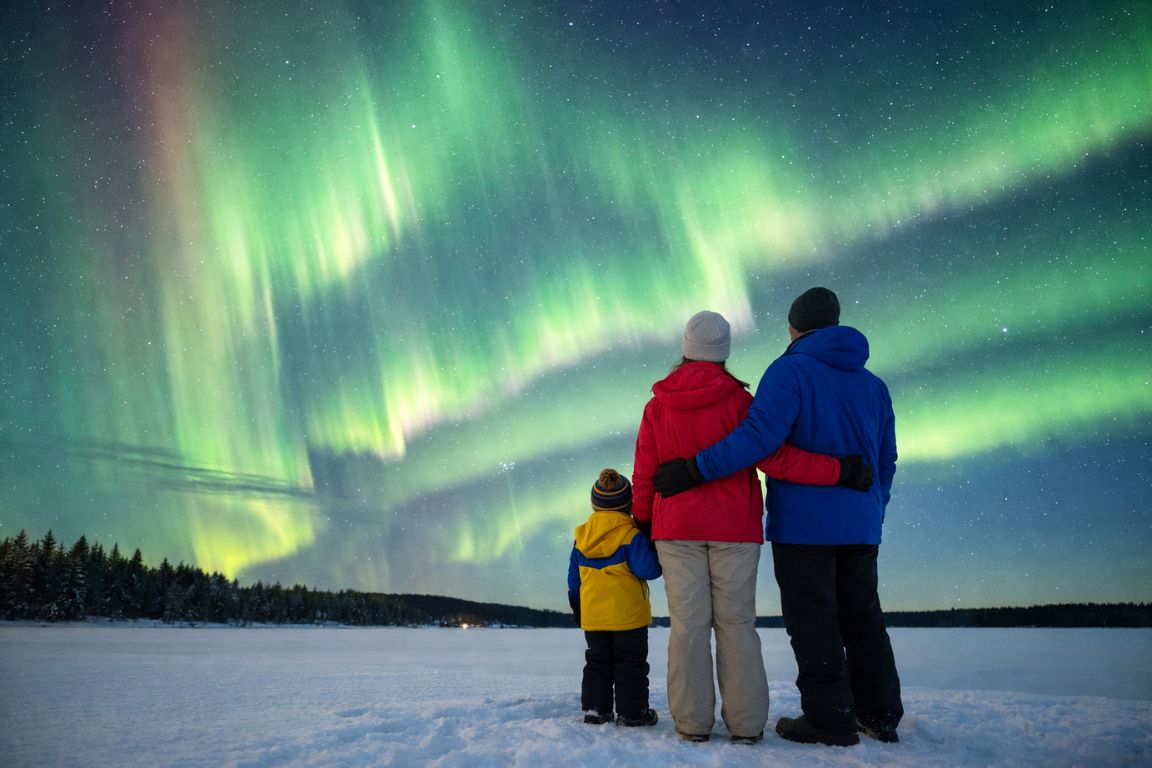 On a clear night with KP 2 to 3 activity and a good viewing spot, a patient self-hunter spending 90 minutes or more has a meaningful chance of seeing aurora. Displays in Rovaniemi most commonly appear as a green arch on the northern horizon that brightens, thickens, and may extend vertically if activity builds. On stronger nights it becomes overhead curtaining. On moderate nights it may stay as a subtle glow that the camera amplifies dramatically. The experience is different from the photographs. The photographs are almost always more vivid than the reality. The reality is still extraordinary.
Let me describe what you are actually likely to see on an average positive self-hunting night in Rovaniemi, because the gap between aurora photos and aurora reality confuses more travelers than almost any other aspect of the experience.
You are standing at the Arctic Garden at 10:45pm. The sky is clear, which you can confirm because Orion is visible in the south and the stars over the river are sharp rather than fuzzy. The Northern Lights Alert app notified you 20 minutes ago. The northern horizon looks dark. You wait. Then you notice something: the sky above the treeline to the north looks slightly less dark than the surrounding sky. Almost like a very pale greenish cloud, but it is not moving like cloud moves. It pulses slightly. This is the beginning of an arch forming.
Over the next 20 minutes, the arch brightens. The green becomes unambiguous. It stretches across perhaps 60 degrees of your horizon, maybe 20 degrees high at the peak. It is beautiful but not overwhelming – you will have seen photographs more dramatic than this. Then at 11:20pm, a burst of activity sends the arch upward. In two minutes it goes from a quiet band to a vertical curtain with an active, rippling edge. Rays shoot upward. The color becomes deeper. Your camera, on a 15-second exposure, shows blazing green from horizon to mid-sky. Your eyes see the same thing but softer, paler, more like a glow with movement than the saturated curtain the camera records. The display lasts about eight minutes at full strength, then subsides back to an arch, then fades to nothing by 11:45pm.
You have just seen the Northern Lights. Not the KP-7 full-sky corona that happens a few times per season and makes grown adults stand in complete silence with tears on their faces. But the real, genuine, Northern Lights of Finnish Lapland, seen from a park in a small Arctic city at midnight, with no guide, no tour bus, no one to tell you what to feel about it. That experience belongs entirely to you.
Not sure where to start? I’ve put together a complete guide on how to plan a trip to Rovaniemi tours – from timing your visit around the Northern Lights to what to pack for Arctic winters.
If you want the full guided experience with mobility, photography, and professional aurora science explained as the lights appear, start with the Northern Lights tours that include a chase, photographs, and a viewing guarantee.
What We See from 9,500+ Travelers Who Self-Hunted
| Self-Hunt Metric | Data Point | Notes |
| % who attempted at least one DIY night | 32% | Usually after their first guided tour or for budget reasons. |
| % who successfully saw aurora independently | 44% | Significantly lower than guided tours (88%+) due to lack of mobility. |
| Most used DIY viewing spot | Arctic Garden (Arktikum) | Accessible by foot from the city center with a dark northern horizon. |
| Most common DIY cold-weather mistake | Standing still too long | Without the “campfire” of a tour, DIYers often freeze and quit early. |
| Most common DIY timing mistake | Giving up before 11:00 PM | Many return to their hotel just as the magnetic “midnight” peak begins. |
| % who said DIY felt more “personal” | 62% | There is a unique thrill to “finding” the lights without a guide. |
| Avg. stay length for successful DIY hunters | 5.5 nights | Independent success requires a longer window to wait out the clouds. |
Frequently Asked Questions
Can you see Northern Lights from Rovaniemi city center?
Yes, on strong activity nights with clear sky. The Aurora has been visible from the main pedestrian street Koskikatu on KP 5 and above events. For KP 2 to 4 activity, you need to move to the darker edges of the city – the Arctic Garden riverbank, the Ounasjoki riverfront, or Ounasvaara hill. The city’s light pollution reduces the visibility of weaker displays but does not block strong ones. Moving 10 to 15 minutes from the main hotel strip dramatically improves what you can see.
What is the best free spot to see Northern Lights in Rovaniemi?
The Arctic Garden behind Arktikum museum is the most accessible – 10 to 15 minutes on foot from most city center hotels, open northern horizon over the river, no transport required. For better conditions with slightly more effort, Ounasvaara hill (30 to 45 minutes walk or 10 minutes by taxi) provides elevation above city glow and a panoramic north-facing view. Both are officially designated aurora viewing areas maintained and recommended by Visit Rovaniemi.
Do you need a car to see Northern Lights in Rovaniemi without a tour?
No, not for moderate to strong displays. On nights with clear sky and KP 3 or above, the lights are visible from walking-distance spots near the city center. A car (or taxi) becomes useful for reaching Olkkajärvi lake (15 km) or the Arctic Circle Hiking Area (20 km), where darker skies make weaker displays visible that the city’s ambient light obscures. For following cloud gaps to other regions of Lapland when cloud covers the city, a car is essential which is why guided tours win on those nights.
What app should I use to see Northern Lights in Rovaniemi?
Use two simultaneously: Northern Lights Alert (nlalert.fi) for real-time camera-verified sightings – alerts fire when the lights are physically confirmed by cameras in Lapland, not just predicted by satellite data. And the Finnish Meteorological Institute cloud service (ilmatieteenlaitos.fi) or Windy for cloud cover mapping. The KP index alone from any standard aurora app is insufficient for real-time decision-making; it measures global activity averages and updates every few hours, not what is happening above your specific sky right now.
How long should you wait outside when aurora hunting without a tour?
A minimum of 90 minutes on a clear, moderately active night. Aurora activity cycles through peaks and quiet periods every 20 to 40 minutes. The most common mistake is checking the sky for 15 to 20 minutes and leaving before an activity cycle builds. If the sky is clear and the Northern Lights Alert app has fired or the KP is above 2, stay for at least 90 minutes before concluding nothing will happen. Use the warmth cycling approach – periodically return to a nearby heated space to rewarm before returning to your viewing spot.
Is it worth seeing Northern Lights without a tour, or should you book a guided experience?
Both are worth it for different reasons. Self-hunting is free, deeply personal, and entirely practical on clear nights with walkable dark spots available. It fails on nights where cloud covers the city but clear sky exists within driving distance which is when a guided tour’s mobility becomes decisive. For travelers with multiple nights and patience, self-hunting produces some of the most memorable experiences of a Lapland trip. For travelers with one or two nights who cannot absorb a clouded-out attempt, a guided tour with unlimited mileage is the more reliable choice.
Want to combine self-hunting flexibility with the security of a tour on nights when cloud chasing matters? Put one evening on the aurora hunt with viewing guarantee and unlimited mileage and self-hunt from the riverbank on the others.
Written by Elias Koskinen
Finnish tour guide since 2012 · Founder, Rovaniemi Tours
Elias has guided over 9,500 travelers through Rovaniemi, Finnish Lapland, and the Arctic Circle since founding the agency.


